
How to Compress GIFs Without Losing Visual Quality: The Definitive Guide
Animated GIFs remain one of the web's most universally supported animation formats. However, because the GIF format (dating back to 1989) lacks modern inter-frame prediction found in video codecs like H.264 or AV1, file sizes can quickly balloon into tens of megabytes for just a few seconds of animation.
Why Are GIF Files So Enormous?#
Unlike modern video codecs that save only the differences between frames using motion vectors and B-frames, raw GIF files encode full raster frames with an LZW compression dictionary. Each pixel references an index in a 256-color palette table. When animations feature gradients, high frame rates (60fps), or subtle lighting changes, every single pixel differs from frame to frame, destroying compression efficiency.
1. Color Palette Optimization#
Reducing your palette from 256 colors to 128 or 64 colors using Median Cut or NeuQuant color quantization can immediately shave 30% to 50% off the total file size with virtually zero perceived degradation on social media platforms.
2. Lossy LZW Compression#
Lossy LZW alters pixels that are nearly identical so that repetitive patterns occur more frequently. This allows the LZW encoder to store long strings of repeating pixels with tiny byte footprints. Tools like Gifsicle and GIF Toolkit's built-in compressor use this to slash file sizes without pixelation.
3. Frame Dropping & Delay Balancing#
Dropping every second frame (e.g. from 30fps down to 15fps) while simultaneously doubling the frame delay from 33ms to 66ms halves the data payload while maintaining normal playback speed. For reaction memes and screen demos, 15fps is virtually indistinguishable from 30fps.
Best Settings for Web and Social Sharing#
When exporting GIFs for Discord, Slack, Twitter, or email campaigns, aim for these standard limits:
- Maximum width: 480px to 640px. High-DPI screens downscale gracefully.
- Frame rate: 12 to 18 fps for real-world footage, 24 fps for 2D UI animations.
- Palette: 128 colors with Floyd-Steinberg dithering disabled for flat graphics, enabled for photography.
Step-by-Step: Compressing With GIF Toolkit#
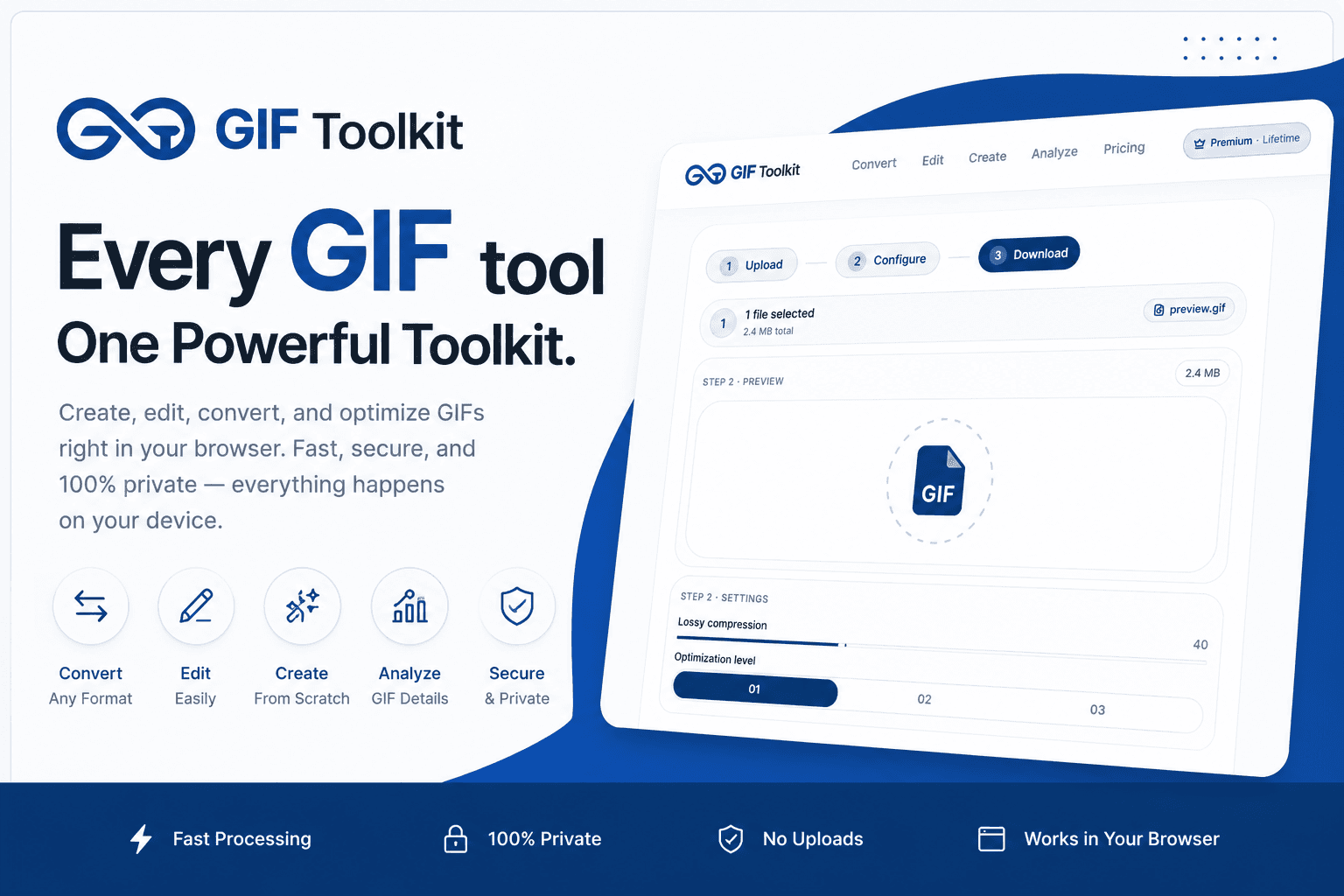
With GIF Toolkit, your files are never uploaded to third-party cloud servers. WebAssembly executes the entire compression engine in memory right on your device. Simply drag your file into our GIF Compressor, choose your compression preset (Light, Balanced, or Aggressive), and download the optimized GIF instantly.
Hassan Abbas
Hassan builds high-performance browser-based multimedia tools and specializes in client-side WebAssembly media encoding.